



Le mappe della disuguaglianza
Una geografia sociale metropolitana
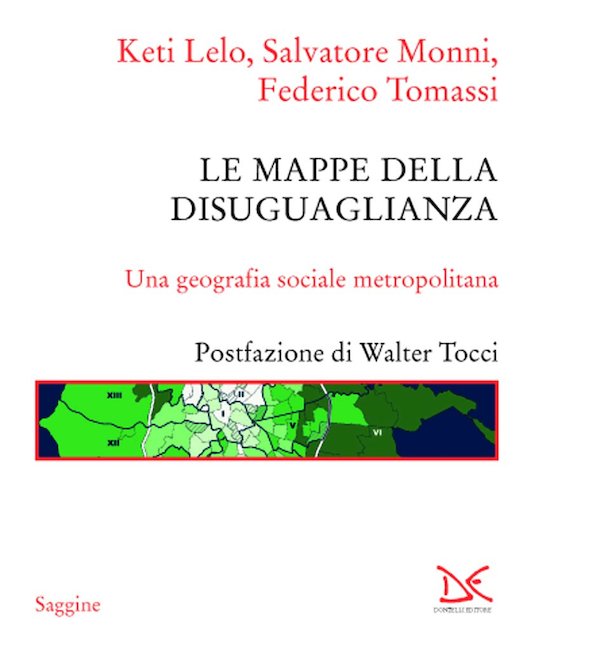
When discussing Rome – as the quintessential example of a complex and stratified urban reality, a synthesis of the difficult journey of metropolises in Europe and around the world – one often falls into the trap of clichés, of the stale vision of a city that no longer exists, of unawareness of how citizens change and where they move. Today, in the era of universal connectivity, once one has moved away from the most beaten paths, in Rome one can have the sensation of taking a leap into the dark and, somewhat like what happened to navigators of the 15th century (they indeed, due to inaccurate maps), of encountering new lands, full of problems but also of potential. The volume – constructed as a journey that unfolds through a detailed series of color maps – traces a geography of inequalities between the neighborhoods of the capital in an unprecedented and valuable comparison with the other three main Italian metropolitan cities: Milan, Naples, and Turin. The authors, driven by great scientific rigor and strong civic passion, return to us the social and spatial complexity of the capital, showing its many facets and the inequalities that traverse it. A complexity that must be reckoned with and from which we must start again. As Walter Tocci observes in the dense essay closing the volume, Rome offers changing faces of itself, like a kaleidoscope, "giving the perception of inexorable disorganization. Yet, to the changing visions of Rome are also linked the hopes for its rebirth." Alongside Rome, therefore, and in comparison with Rome, other great realities: Milan, Naples, and Turin. Of these four metropolitan cities, the neighborhoods and municipalities of the hinterland are scrutinized on themes that closely concern citizens: from transportation to schools, from tourism to the environment, from healthcare to the presence of foreigners, and on which the weight of socio-economic inequalities bears daily. These extensive urbanized territories, highly diversified, little known and in continuous evolution, need to be thoroughly investigated with tools capable of focusing on problems, critical issues, and differences. For this reason, the work is not limited to analyzing their characteristics in aggregate terms, but investigates the cities through indicators with a much finer level of territorial detail: the 155 urban planning zones of Rome, the 88 local identity nuclei of Milan, the 94 statistical zones of Turin, and the 30 neighborhoods of Naples. The hope is that these maps will be consulted by many, but especially by those who must think and design policies.
The authors are the creators of www.mapparoma.info, the website where they make available the materials from their analyses of the city, conducted at the level of detail of urban planning zones, which allows for the most precise examination of differences between neighborhoods.