


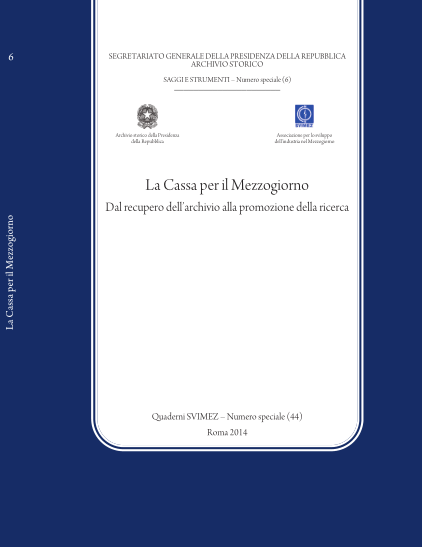
La Cassa per il Mezzogiorno
Dal recupero dell’archivio alla promozione della ricerca
Concern for safeguarding the archive and library of the Cassa per il Mezzogiorno arose when the Department for Development and Cohesion (DPS) of the Ministry for Productive Activities took action to recover the premises located in Via del Giorgione, where the most substantial part of the archive was housed. Credit goes to Dr. Stefania Cantagalli, DPS librarian, for promptly alerting Dr. Stefania Greco, Svimez librarian, about the risks of dispersion or destruction that the documentary and bibliographic material could face. Professor Amedeo Lepore, Svimez counselor, was informed of the situation and contacted Dr. Emanuela Marinelli from the Archival Superintendence for Lazio and Professor Paola Carucci, who at the time of the first interventions on the Casmez-Agensud archive was superintendent of the Central State Archive, subsequently activating a synergy between people interested in preserving the archival heritage and historical-economic research. Professor Lepore immediately took steps to establish, at Svimez, in agreement with President Adriano Giannola and President Emeritus Nino Novacco, a Working Group representing various competencies to create an organic project for safeguarding the archive and enabling its full use for research purposes. The challenge of the undertaking lies in the exceptional dimensions of an archive that reflects an important part of Southern Italy's history. To date, the actual extent of the entire archive has not been determined, including parts transmitted to other ministries and regions: it comprises over 30 kilometers of documents. The Working Group first met, at the initiative of Svimez's Board of Directors, at the institution's headquarters on June 20, 2012. At that date, the Group included Professor Adriano Gianola, Svimez president, Professor Amedeo Lepore, Svimez counselor and group coordinator, and for Svimez: Dr. Riccardo Padovani, director, Dr. Agnese Claroni, researcher, and Dr. Susanna Greco, librarian; the Group also included Dr. Stefania Cantagalli, PDS librarian, Professor Paola Carucci, now superintendent of the Historical Archive of the Presidency of the Republic, Dr. Agostino Attanasio, superintendent of the Central State Archive (ACS) and Dr. Paola Puzzuoli, responsible for the Casmez archive at ACS; Professor Lilia Costabile from the University of Naples Federico II, Professor Donatella Strangio from Sapienza University of Rome, Dr. Stefania Manfrellotti from the University of Naples Federico II, Professor Emanuele Felice from the Autonomous University of Barcelona (via phone), Dr. Alessandro Höbel, PhD in history. In subsequent meetings, other representatives of institutions interested in the fate of the Cassa per il Mezzogiorno archive would be included in the Group. The Group was immediately informed about which part of the archive was already at the Central State Archive, having been transferred there following a complex operation of selection and transfer of substantial portions of the archive to ministries that succeeded the Cassa in exercising certain functions, carried out by a Working Group established by the Presidency of the Council in December 1997. The first objective of the Working Group coordinated by Professor Lepore was to conduct a survey of the documentary material located in the Via del Giorgione premises and the bibliographic material of the Cassa concentrated in a deposit in Castelnuovo di Porto. The superintendent of the Central State Archive, the institution designated for preserving the Cassa per il Mezzogiorno archive as a suppressed national public entity, offered to acquire the documentary material from the Via del Giorgione premises, uniting it with the documentation already in their possession, along with the bibliographic material from Castelnuovo di Porto. Temporarily, the enormous documentary complex from Via del Giorgione was transferred to a location outside Rome, waiting to be brought to the Central State Archive, an operation that subsequently occurred for part of the documentation, pending final arrangement. The Group also decided to organize a seminar - held at the Historical Archive of the Presidency of the Republic - titled "The Cassa per il Mezzogiorno: From Archive Preservation to Research Promotion," which represented the starting point of this publication, realized through a collection of original essays and testimonies - including from authors who did not participate in the meeting - resulting from the stimulus for scientific investigation that arose during that first discussion opportunity. The Group also worked towards the recovery of the Cassa archive. A decisive role was played by the Department for Cohesion and Development of the Ministry for Productive Activities, with the approval of the project titled "Archives for Territorial Economic Development (ASET). Innovative Models of Conservation and Reuse of Sources for the History of Extraordinary Interventions for Southern Italy's Development," funded under the National Operational Programme 2007-2014. The project will be implemented at the Central State Archive, according to the following phases: reorganization and inventory of the unified documentation; computerization of the completed inventory; development of research tools, to be proposed on an IT platform, to allow access to inventory data via web; digital reproduction of images to be linked to the most significant documents; development of data sets to be published in open formats to adhere to public administration's orientation in favor of open data. A "steering committee," composed of the main institutions interested in the recovery and enhancement of the Cassa per il Mezzogiorno archive, will closely monitor the situation to verify the progress of the project phases and its completion. The publication of these scientific contributions in a unified and solemn form aims to represent recognition of one of the highest moments of State intervention in Southern Italy, with an approach aimed at overcoming any simplification of the Cassa's history, highlighting its main characteristics and capturing both its positive results, which contributed to the Italian "economic miracle," and the shadows that marked its second and final phase of activity. At the same time, this publication is the concrete sign of a research commitment that intends to continue, promoting broad enhancement of documentation of great value for reconstructing and innovating the history of economy, institutions, and society during a significant period of the Italian Republic.